Contents
Best Bass Traps for Home Studios (2026)
TL;DR: Bass traps are the single most impactful acoustic treatment you can add to a home studio. The best bass traps combine broadband absorption with low-frequency control — top picks include the Acoustimac DMD Panel, GIK Acoustics 244 Bass Trap, and Auralex LENRD. Corner placement delivers the most return per dollar in rooms under 400 sq ft.
Why Bass Traps Matter More Than Any Other Treatment
Bass buildup is the root cause of muddy mixes, inaccurate monitoring, and bass notes that vanish on playback outside the room. Low frequencies (20–250 Hz) accumulate in room corners where pressure is highest, creating standing waves that color everything you hear. Bass traps target exactly that problem — broadband panels and diffusers don’t.
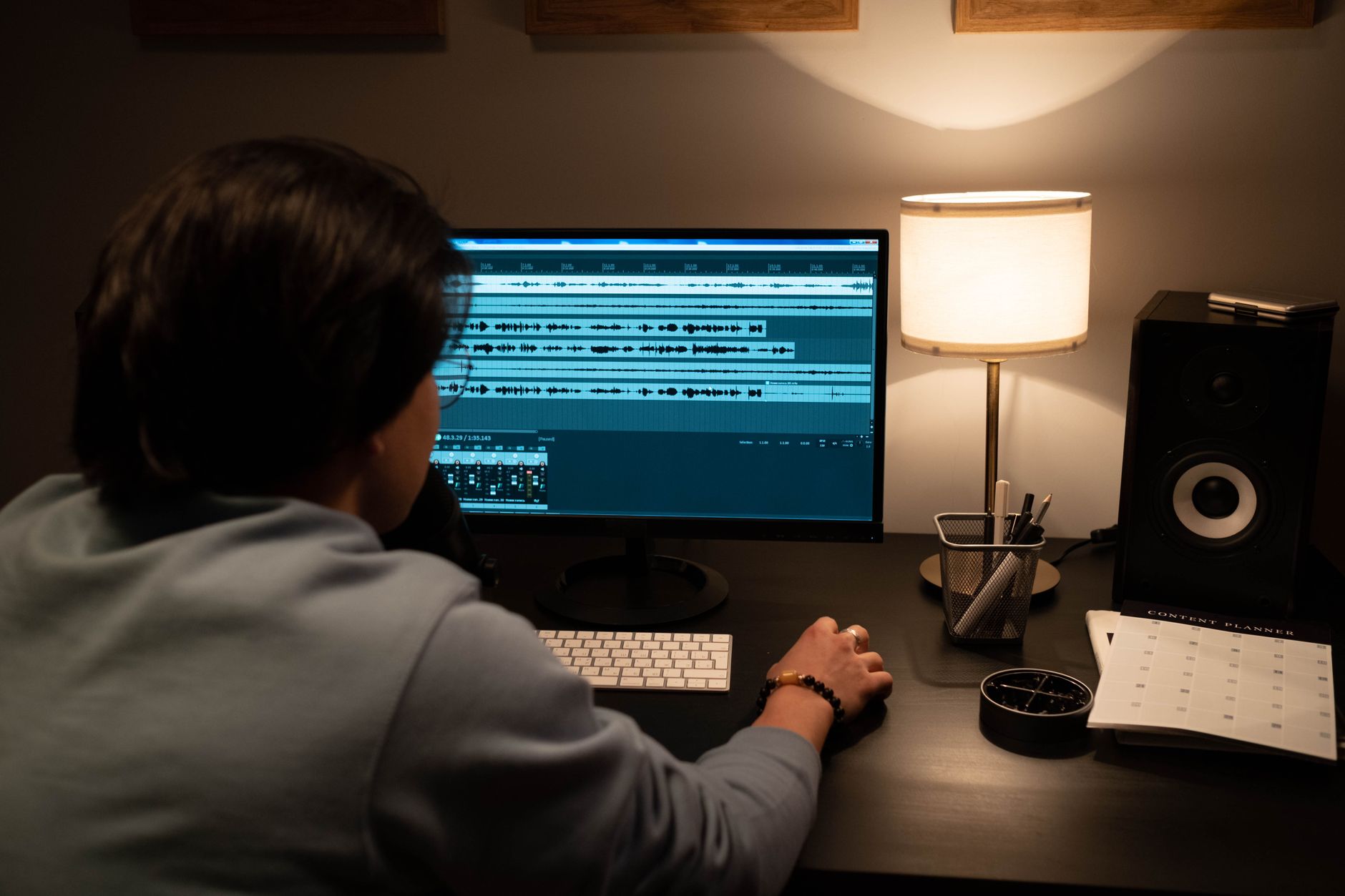 Photo: cottonbro studio via Pexels
Room modes are unavoidable physics. Any parallel surfaces create standing waves at frequencies where the room dimension equals half a wavelength (or multiples). A 10-foot room has a primary axial mode at ~56 Hz. Stack multiple room dimensions and you get a comb of resonances that no EQ can fix — they’re in the room, not the signal chain.
Standard acoustic foam and thin panels absorb mid and high frequencies well but are largely transparent to bass. Effective bass treatment requires material thickness of 4 inches or more, or tuned resonator designs (membrane/Helmholtz traps) targeting specific problem frequencies.
How to Choose the Best Bass Traps for Your Room
The right bass trap depends on three things: your worst problem frequency, your room volume, and your budget. Rooms under 200 sq ft almost always need broadband corner traps floor-to-ceiling. Larger rooms with specific resonance problems may benefit from tuned membrane traps at specific frequencies. Start broadband, tune later.
 Photo: V Marin via Pexels
Room Size and Placement Priority
| Room Size | Priority Placement | Minimum Traps | Recommended |
|---|---|---|---|
| Under 100 sq ft | Tri-corners (floor-to-ceiling) | 4 | 8 |
| 100–200 sq ft | Tri-corners + front wall | 4 | 8–12 |
| 200–400 sq ft | All corners + first reflection | 8 | 12–16 |
| 400+ sq ft | Full perimeter corners | 12 | 16+ |
Tri-corner placement (where two walls meet the ceiling or floor) targets all three axial dimensions simultaneously. A single 2×4 ft panel floor-stacked in a tri-corner outperforms three panels scattered across flat walls.
Absorption Coefficient vs. Frequency
Published NRC (Noise Reduction Coefficient) ratings are averaged across 250–2000 Hz — largely useless for evaluating bass trap performance. Look instead for published absorption data at 125 Hz and 63 Hz. Products with certified testing by third-party labs (Riverbank, Intertek) are worth the premium.
Best Bass Traps: Top Picks by Category
Best Overall: GIK Acoustics 244 Bass Trap
The GIK 244 is the benchmark broadband corner trap for home studios. At 4 inches thick with rigid fiberglass core, it delivers measurable absorption down to 80 Hz. Third-party tested absorption data is published on GIK’s site — rare in this category. Custom sizing, fabric colors, and a frequency range extender option (FlexRange) make it adaptable to almost any room.
The 244 ships flat-packed and installs with corner brackets or impaling clips. The standard 2×4 ft panel weighs about 7 lbs, so drywall anchors handle it without studs. Published absorption coefficients show a 0.86 NRC at 250 Hz dropping to approximately 0.45 at 125 Hz — better low-end performance than most foam alternatives at twice the thickness.
The FlexRange treatment adds a decoupled membrane layer that extends effective absorption below 80 Hz. For rooms with a documented resonance between 40–80 Hz, it’s worth the upcharge. For general use, the standard 244 panel is sufficient.
Best Budget Pick: Acoustimac DMD Acoustic Panel
Acoustimac’s DMD panels use compressed recycled cotton instead of fiberglass, which makes them easier to handle without protective gear. At roughly half the price of GIK per square foot, they’re the practical starting point for producers treating a room on a strict budget. Absorption performance is solid through 125 Hz at 4-inch thickness.
The tradeoff is fabric choice — Acoustimac’s color selection is limited compared to GIK, and custom sizing costs more relative to the base price. For corner traps where appearance is secondary, that’s a non-issue. Stack two panels vertically in each corner for floor-to-ceiling coverage.
Best Foam Option: Auralex LENRD Bass Trap
The LENRD (Low-End Node Reduction Device) is the most widely installed foam bass trap in home studios. Wedge-shaped for corner placement, it’s self-adhesive, lightweight, and sold in eight-packs sized for one complete corner run. Effective absorption starts around 125 Hz — it won’t touch deep bass below 80 Hz, but it handles the 100–250 Hz problem range most bedroom studios struggle with most.
Foam traps have a real limitation: density. Acoustic foam at 2–3 lb/ft³ absorbs less at any given frequency than rigid fiberglass or mineral wool at the same thickness. The LENRD compensates with its geometry — the wedge profile stacks against both wall surfaces in a corner, creating an effective 4-inch average depth without requiring two separate panels.
For renters who can’t mount rigid panels with hardware, LENRD blocks can be leaned into corners without adhesive. Absorption degrades slightly but remains useful.
Best Premium/Tuned Option: Acoustics First Cumulus Broadband Diffusor/Trap Hybrid
Ceiling cloud and rear-wall positions sometimes benefit from diffusion rather than pure absorption. The Acoustics First Cumulus combines a QRD diffusor surface with an absorptive substrate — it breaks up early reflections while simultaneously controlling bass buildup behind the diffusor fins. Best suited for rooms where over-damping is a risk.
Over-treatment is a real problem in small rooms. A fully absorbed space (RT60 below 0.15 seconds) sounds unnatural and fatiguing. The Cumulus earns its premium price in rooms where corner traps are already in place and the remaining problem is flutter echo plus residual low-mid buildup.
Best DIY-Substitute: Rockwool Safe’n’Sound 2×4 ft Panels
Rockwool Safe’n’Sound is the acoustic treatment community’s preferred DIY core material. At 3 inches thick and 2.5 lb/ft³ density, it outperforms most retail foam traps at a fraction of the per-square-foot cost. Building corner traps with Safe’n’Sound + lumber + fabric is a half-day project that matches or exceeds commercial products at 30–40% of the retail price.
The only investment is time. A standard 2×4 ft frame takes about 20 minutes to build from 1×4 lumber, two sheets of Rockwool, and a yard of acoustic fabric. Published absorption coefficients for Safe’n’Sound at 4-inch thickness show performance comparable to GIK 244 panels across the 125–4000 Hz range.
Bass Trap Placement: Step-by-Step Workflow
Signal Chain Reference
Monitor output → Room reflections → Ears
                       ↓
              Standing waves accumulate in corners
                       ↓
              Bass traps at corners absorb excess pressure
                       ↓
              Flatter in-room frequency response
Placement Sequence
-
Identify your worst tri-corners first. Stand in your mix position. The floor-to-ceiling corners directly behind your monitors are priority one. These corners are where front-wall bass reflections combine with floor and ceiling modes.
-
Measure before placing (optional but recommended). A free room measurement with REW (Room EQ Wizard) and a calibrated USB mic (MiniDSP UMIK-1 is the standard) takes 20 minutes and shows exactly which frequencies are problematic. This prevents over-treatment.
-
Floor-stack your largest traps in the front two corners. Place 4-inch panels stacked floor to ceiling (or as close as possible). Panels should sit in the corner, not flat against the wall.
-
Add rear corner traps. The back corners handle reflections returning from the rear wall. Tri-corner placement at the top rear corners is particularly effective for ceiling mode control.
-
Check the first reflection points on side walls. Broadband panels (not necessarily bass traps) at side-wall first-reflection points reduce comb filtering from early reflections.
-
Re-measure and listen. Compare your waterfall plot before and after. You’re looking for modal peaks to reduce in amplitude and decay time to shorten below 500ms at bass frequencies.
Troubleshooting Matrix
| Symptom | Likely Cause | Fix |
|---|---|---|
| Bass sounds hollow/thin in mix | Over-treatment, RT60 too low | Remove traps from one corner, re-measure |
| Specific note booms in room | Axial room mode at that frequency | Target tri-corner at the parallel wall pair causing the mode |
| Bass sounds good in studio, thin elsewhere | Room is boosting bass; you’re compensating | Add more broadband treatment, especially floor-ceiling axis |
| Treatment has no effect below 100 Hz | Material too thin (< 4 inches) | Replace with 4“+ rigid fiberglass or membrane trap |
| High frequencies went dead after treatment | Panels absorbing too broadly | Replace with tuned trap or add diffusion at rear wall |
 Photo: Pramod Tiwari via Pexels
DIY Bass Traps vs. Commercial Products
| Factor | DIY (Rockwool) | Commercial (GIK 244) |
|---|---|---|
| Cost per 2×4 ft panel | ~$15–25 | ~$55–75 |
| Build time | 30–45 min/panel | Zero |
| Absorption performance | Comparable at 4 in | Certified tested data |
| Fabric/finish options | Unlimited | ~20 options |
| Structural integrity | Depends on builder | Consistent |
| Resale value | Minimal | Moderate |
For producers building 8–12 panels, DIY pays for a decent audio interface in savings. For producers who want proven performance data and a cleaner finish, commercial panels justify the cost.
→ See also:
- Home Studio Acoustic Treatment Guide (2026)
- How to Acoustically Treat a Room for Recording
- How to Soundproof a Room for Recording
FAQ
Q: How many bass traps do I need for a home studio? Start with four — one in each floor-to-ceiling corner. For rooms under 200 sq ft, eight traps (adding ceiling tri-corners) will show a meaningful improvement in waterfall plots. More traps past that point yield diminishing returns unless specific resonances remain.
Q: Do bass traps work for soundproofing? No. Bass traps and soundproofing are completely different problems. Bass traps absorb acoustic energy inside your room to improve how it sounds. Soundproofing prevents sound from traveling between spaces — it requires mass, decoupling, and airtight construction. Adding bass traps won’t reduce bleed into adjacent rooms.
Q: What’s the minimum thickness for an effective bass trap? Four inches of rigid fiberglass or mineral wool is the practical minimum for meaningful absorption at 125 Hz. Thinner materials help at mid and high frequencies but are largely transparent to bass. Membrane (panel) traps can target specific low frequencies at less thickness but have narrower bandwidth.
Q: Where should I NOT place bass traps? Avoid covering your entire rear wall with absorption if your room is already small and treated. A fully dead room (no diffusion, no liveness) causes ear fatigue and makes it hard to judge reverb and spatial characteristics accurately. Leave some reflective surfaces — typically the rear wall gets a mix of absorption and diffusion.
Q: Can I use moving blankets instead of bass traps? Moving blankets help with mid and high frequencies at best. They have no meaningful absorption below 250 Hz because they’re too light and thin. For treating bass buildup, blankets are not a substitute for dense fibrous materials. They can reduce flutter echo and early reflections as a temporary measure while you source proper treatment.
Q: Are corner bass traps better than flat-wall panels? Yes, for bass control specifically. Corner placement targets acoustic pressure maxima — the spots where standing wave energy is highest. A 2×4 ft panel in a corner absorbs significantly more low-frequency energy than the same panel mounted flat on a wall, even though the material is identical. For mid and high frequency first-reflection control, flat-wall placement is appropriate.
Editorial methodology: Assessments are based on manufacturer specifications, published user reviews, and editorial research. Physical hands-on testing is noted explicitly where it occurred. Rankings reflect our editorial judgment and are not influenced by affiliate commission rates. Full editorial policy · Affiliate disclosure