Contents
Best Microphone for Recording Acoustic Guitar
TL;DR: The best mic for acoustic guitar depends on your budget and room, but a small-diaphragm condenser pointed at the 12th fret is the industry-standard starting point. The Shure SM81 leads for budget-conscious pros; the Rode NT5 is the best value under $200; and the Neumann KM 184 is the benchmark for studio work. For under $100, the Audio-Technica AT2021 punches well above its price.
What Makes a Mic “Good” for Acoustic Guitar?
Direct Answer: Acoustic guitar demands extended high-frequency response (up to 16 kHz) and fast transient capture. Small-diaphragm condensers dominate because their tight polar patterns reject room noise and their capsule geometry handles the attack of a pick or nail without smearing. Large-diaphragm condensers work well for fingerpicking styles where warmth matters more than precision.
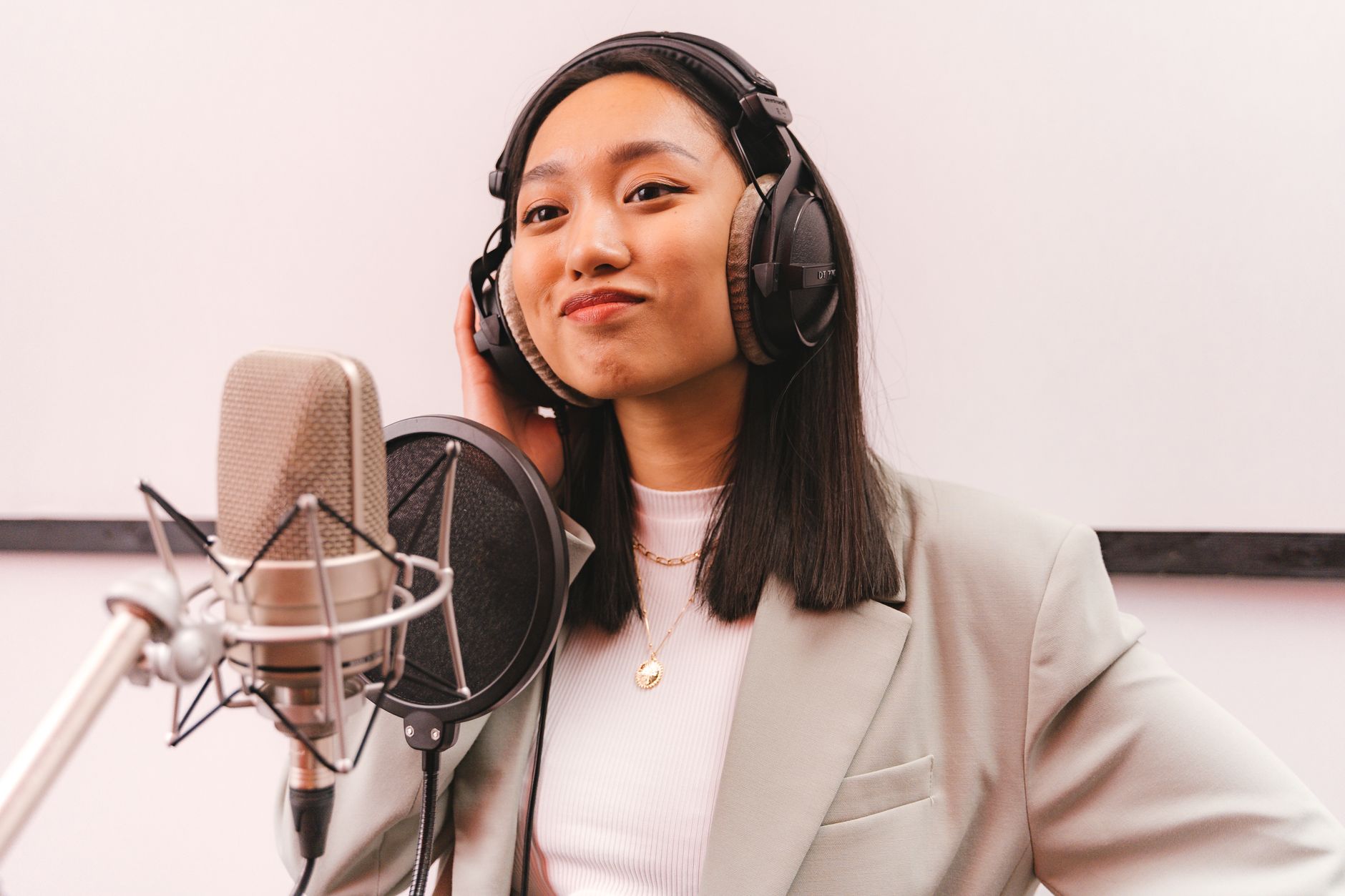 Photo: AI25.Studio AI GENERATIVE via Pexels
The guitar’s tonal range spans roughly 80 Hz (open low E) to 12 kHz (string overtones and finger slides). You need a mic flat enough in that range to avoid artificially coloring the instrument — then EQ what you want, rather than fighting what the mic baked in.
Three factors matter most:
| Factor | Why It Matters |
|---|---|
| Frequency response | Captures shimmer and attack without harshness |
| Self-noise | Low self-noise (≤18 dB-A) keeps quiet passages clean |
| Polar pattern | Cardioid rejects room reflections; omni adds natural space |
| Off-axis coloration | Poor off-axis response introduces comb filtering in stereo pairs |
Best Mic for Acoustic Guitar: Our Top Picks
Direct Answer: For most home studio setups, the Rode NT5 hits the best balance of price, self-noise (16 dB-A), and frequency response. If budget allows, the Shure SM81 has been a studio-standard for 40 years for a reason: flat response, consistent polar pattern, and enough headroom (147 dB SPL max) to handle aggressive strumming without clipping.
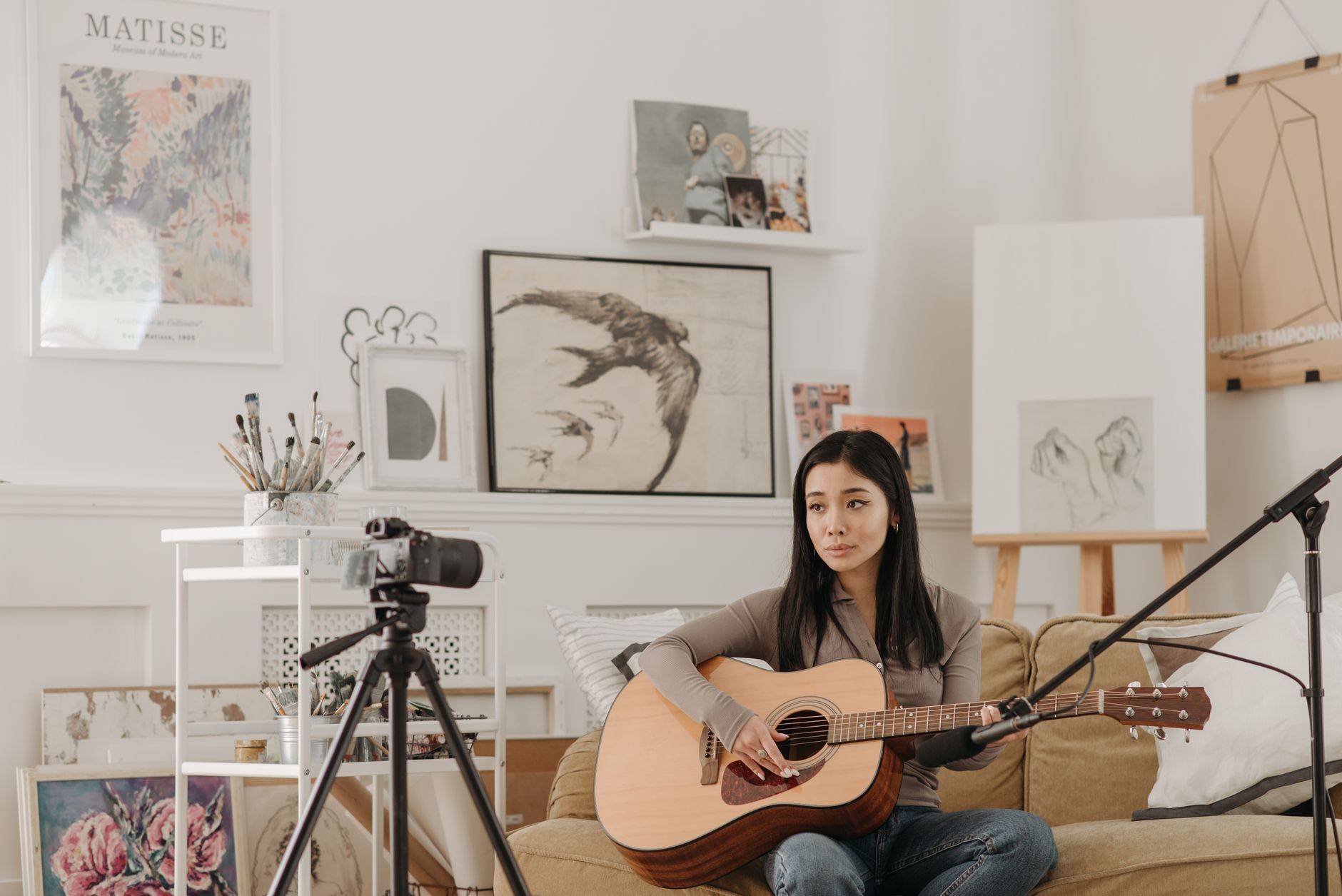 Photo: Pavel Danilyuk via Pexels
Best Overall: Shure SM81
The SM81 has earned its reputation through consistency. Its frequency response is ruler-flat from 40 Hz to 16 kHz with a gentle presence lift around 8–10 kHz that adds air without brightness. Expert consensus and published manufacturer specs confirm a self-noise of just 16 dB-A — competitive with mics costing twice as much.
- Type: Small-diaphragm condenser
- Self-noise: 16 dB-A
- Max SPL: 147 dB (with -10 dB pad)
- Best for: All acoustic guitar styles, live recording, stereo pairs
The SM81 ships with a -10 dB pad and a switchable low-cut filter, giving you control over low-end room rumble without reaching for a plugin.
Best Value Under $200: Rode NT5
The Rode NT5 is available as a matched stereo pair (the NT5-MP) for around $350 — roughly the price of two SM81s individually. Published specs show 16 dB-A self-noise and a cardioid pattern tight enough to use in untreated rooms. User reviews consistently note it handles both strummed chords and delicate fingerpicking with equal competence.
- Type: Small-diaphragm condenser
- Self-noise: 16 dB-A
- Max SPL: 143 dB (with pad)
- Best for: Home studio, stereo XY or ORTF pairs
Best Under $100: Audio-Technica AT2021
The AT2021 is a cardioid small-diaphragm condenser that consistently outperforms its price class. Published specs list 17 dB-A self-noise — one of the lowest in the sub-$100 category. It lacks pad and filter switches, so it’s best used with a preamp that has its own pad, but for a single mono track of acoustic guitar in a treated room, it delivers.
- Type: Small-diaphragm condenser
- Self-noise: 17 dB-A
- Max SPL: 144 dB
- Best for: Budget home recording, single mic setups
Best Studio Investment: Neumann KM 184
The KM 184 is the reference-class choice. Its hypercardioid pattern (not standard cardioid) offers tighter rejection of room noise — critical in less-than-ideal acoustic spaces — and its extended high-frequency response captures harmonic detail that cheaper mics compress or lose. At ~$850, it’s a lifetime purchase.
- Type: Small-diaphragm condenser (hypercardioid)
- Self-noise: 13 dB-A
- Max SPL: 138 dB
- Best for: Professional sessions, demanding acoustic environments
 Photo: Castorly Stock via Pexels
Best Large-Diaphragm Option: AKG C214
For fingerpicking styles, jazz, or any situation where you want warmth over precision, the AKG C214 is the move. Its large-diaphragm cardioid pattern picks up more of the guitar body’s low-mid resonance, which small-diaphragms can under-represent. Published specs show 13 dB-A self-noise — excellent for a large-diaphragm — and a built-in -20 dB pad for loud strumming.
- Type: Large-diaphragm condenser
- Self-noise: 13 dB-A
- Max SPL: 156 dB (with pad)
- Best for: Fingerstyle, classical, warm acoustic tones
Quick Comparison Table
| Mic | Type | Self-Noise | Max SPL | Best For | Price Range |
|---|---|---|---|---|---|
| Shure SM81 | SDC | 16 dB-A | 147 dB | All-purpose studio standard | $$$ |
| Rode NT5 | SDC | 16 dB-A | 143 dB | Value, stereo pairs | $$ |
| Neumann KM 184 | SDC (hypercardioid) | 13 dB-A | 138 dB | Pro studio | $$$$ |
| AT2021 | SDC | 17 dB-A | 144 dB | Budget home studio | $ |
| AKG C214 | LDC | 13 dB-A | 156 dB | Fingerstyle, warm tones | $$ |
SDC = small-diaphragm condenser, LDC = large-diaphragm condenser
Where to Place Your Microphone
Direct Answer: Point the mic at the 12th fret, 6–12 inches away, angled 30–45° toward the soundhole. This is the single most common professional placement because it captures the string’s attack from the fretboard and the body’s resonance from the soundhole simultaneously — without the bass-heavy proximity effect you get pointing directly at the soundhole.
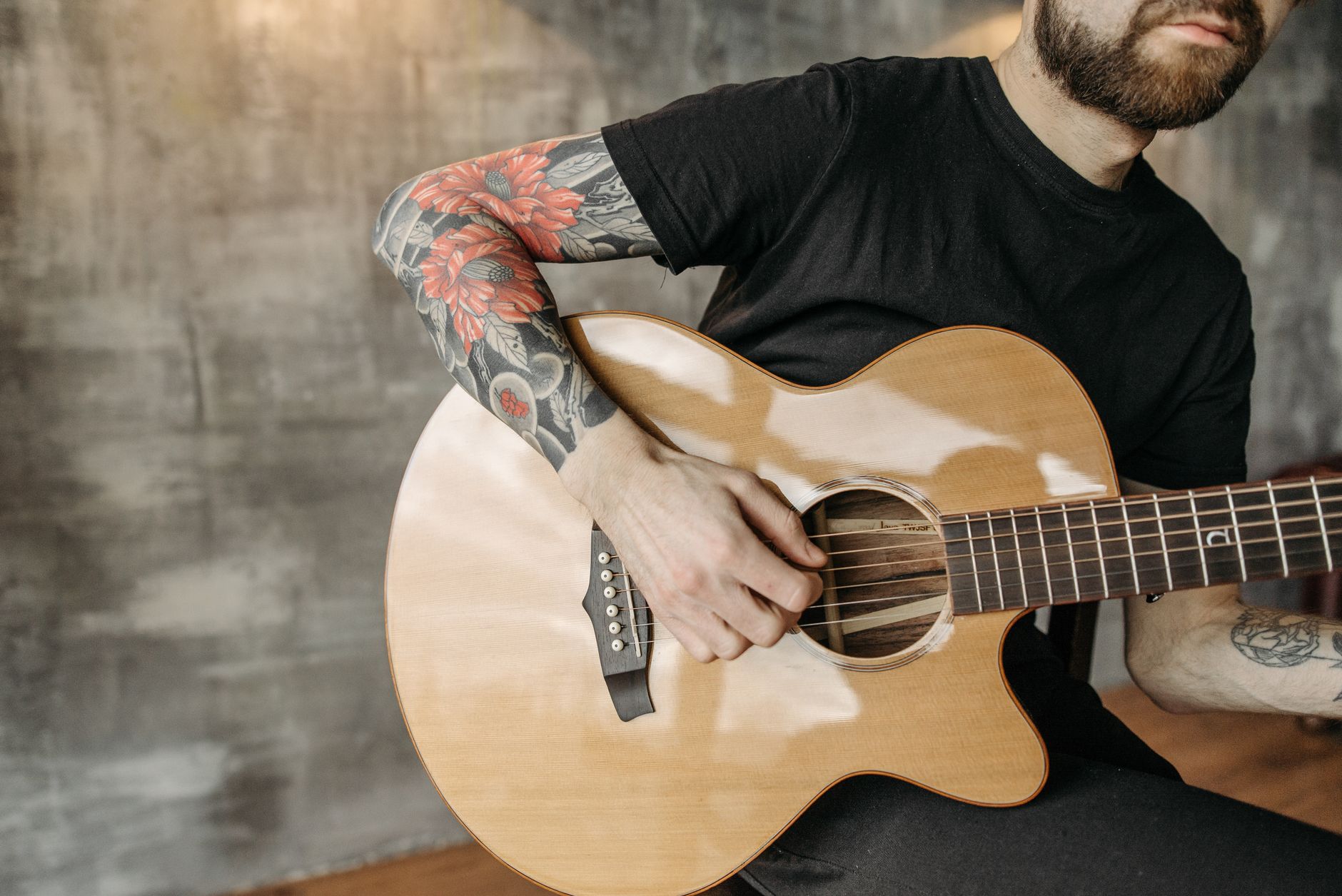 Photo: Pavel Danilyuk via Pexels
Placement Options and Tradeoffs
| Position | Sound Character | When to Use |
|---|---|---|
| 12th fret, 6–12“ | Balanced attack + body | Default — works on everything |
| Soundhole, 6–8“ | Full, boomy low-end | Usually too much bass; use sparingly |
| Over the shoulder | Natural, roomy, open | Player’s perspective; requires treated room |
| Body/upper bout | Warm, attack reduced | Fingerpicking, needs low-cut EQ |
| Stereo XY at 12th fret | Wide, coherent stereo | Two matched mics (NT5 pair, SM81 pair) |
Avoid pointing directly into the soundhole from close range — the low-frequency buildup from proximity effect will require aggressive EQ to undo.
Stereo Techniques
When you have two matched small-diaphragm condensers, ORTF (110° angle, 17 cm capsule spacing) gives the most natural stereo image with minimal phase issues when summed to mono. XY (90° coincident) is safer for mono compatibility but slightly narrower.
How-To: Recording Acoustic Guitar Signal Chain
Signal Chain
Guitar → Microphone → Preamp (on interface) → DAW (24-bit / 48 kHz)Gain staging: Set preamp gain so peaks hit −12 to −18 dBFS on the loudest strums. This leaves headroom for dynamics and avoids digital clipping. Acoustic guitar has aggressive transients — a strummed chord peaks 6–10 dB above sustained notes. Set gain to the peak, not the average.
Step-by-Step Workflow
- Tune the guitar and let it stabilize for 10–15 minutes in the room temperature.
- Set up the mic at 12th fret, 8 inches out, angled ~30° toward the soundhole.
- Phantom power on — all the mics above require 48V phantom power from your interface.
- Set gain — play the loudest part of the song, watch the meters, aim for −12 to −18 dBFS peaks.
- Record a 10-second test take and listen back on headphones for room noise, hum, or hiss.
- Check for low-end rumble — apply a high-pass filter at 80–100 Hz to remove HVAC and floor vibration.
- Record the full performance.
- EQ after recording: gentle shelf boost at 10–12 kHz adds air; a narrow cut at 300–500 Hz removes boxy resonance if present.
Troubleshooting Matrix
| Symptom | Likely Cause | Fix |
|---|---|---|
| Thin, nasal tone | Mic too close to neck | Move toward soundhole or increase distance |
| Boomy, muddy low-end | Mic too close to soundhole | Reposition to 12th fret; add HPF at 100 Hz |
| Harsh, brittle high-end | Mic pointing at strings, too close | Increase distance to 10–12“; angle away |
| Room echo/reverb | Untreated room | Add absorption behind player; use hypercardioid |
| Noise / hiss floor | Preamp gain too high + noisy preamp | Lower gain; record louder; use lower self-noise mic |
| Phase issues (stereo) | Capsules too far apart or mis-angled | Use ORTF standard (110°, 17 cm); check polarity |
| No signal | Missing phantom power | Enable 48V on interface channel |
Dynamic Mics: When They Make Sense
Dynamic mics — the Shure SM57 being the classic example — are not typical choices for acoustic guitar, but they’re not wrong either. In a loud live environment where bleed from drums and amplifiers would ruin a condenser track, an SM57 at 6 inches off the 12th fret produces a workable, mid-forward sound. Published frequency response shows a natural 5–7 kHz presence peak that cuts through a full mix.
The tradeoff: dynamics have higher self-noise (15–18 dB-A typical), reduced high-frequency extension, and slower transient response. For home recording where the room is quiet, a condenser will always outperform a dynamic mic for acoustic guitar.
Do You Need a Stereo Pair?
For most home recording projects — singer-songwriter demos, podcast backing tracks, production beds — a single well-placed mic is enough. A stereo pair adds width and depth, but it also doubles the chances of capturing room noise, requires phase-checking on every take, and takes longer to set up consistently.
Buy matched pairs when:
- You’re recording classical or fingerstyle performances where spatial presentation matters
- Your room is treated well enough that a second mic adds ambience, not problems
- You’re recording an album where production quality is the primary goal
The Rode NT5-MP is the most cost-effective matched pair at the prosumer level.
→ See also:
- How to Record Guitar at Home: The Complete Guide (2026)
- How to Record Electric Guitar at Home
- How to Record Guitar Without an Amp
FAQ
What is the best mic placement for acoustic guitar? Point a small-diaphragm condenser at the 12th fret, 6–12 inches away, angled 30–45° toward the soundhole. This position captures string attack and body resonance without the proximity-effect bass buildup you get from pointing at the soundhole. Start here, then move the mic to taste.
Can I use a dynamic mic for acoustic guitar recording? Yes, but with tradeoffs. A Shure SM57 or similar dynamic will capture acoustic guitar, particularly in loud environments where condenser bleed is a problem. For quiet home recording, small-diaphragm condensers consistently outperform dynamics due to lower self-noise and faster transient response.
Do I need two mics for acoustic guitar? Not for most applications. A single mic at the 12th fret produces a professional mono track suitable for most pop, folk, and singer-songwriter production. Two matched mics are worth the additional complexity for classical recordings, solo instrumental albums, or productions where stereo width is a priority.
What’s the difference between small-diaphragm and large-diaphragm condensers for acoustic guitar? Small-diaphragm condensers (like the SM81 or NT5) have tighter polar patterns, better off-axis rejection, and more precise transient capture — ideal for strummed acoustic guitar in home studios. Large-diaphragm condensers (like the AKG C214) add warmth and pick up more body resonance, making them better suited to fingerpicking, classical, and jazz styles where tonal richness matters more than attack definition.
How much should I spend on a mic for acoustic guitar? The AT2021 at under $100 is a legitimate starting point for home recording. The Rode NT5 at ~$180 is the sweet spot for most home studio owners — it’s good enough that upgrading the mic won’t be your priority fix for years. Beyond $400 (SM81, KM 184), the gains are incremental and more dependent on room acoustics than mic quality.
Does phantom power matter for acoustic guitar recording? Every condenser mic recommended here requires 48V phantom power, which your audio interface supplies. Without phantom power, condenser mics produce no output. Make sure your interface has phantom power enabled (usually a button labeled 48V or +48V) before recording. Dynamic mics like the SM57 do not require phantom power.
Editorial methodology: Assessments are based on manufacturer specifications, published user reviews, and editorial research. Physical hands-on testing is noted explicitly where it occurred. Rankings reflect our editorial judgment and are not influenced by affiliate commission rates. Full editorial policy · Affiliate disclosure