Contents
Yamaha HS8 vs Yamaha HS7: Which Should You Buy?
TL;DR: The yamaha hs8 vs yamaha hs7 decision comes down to room size and low-end accuracy. Get the HS8 if your room is 150 sq ft or larger and you need honest bass representation down to 38 Hz. Get the HS7 if you’re working in a smaller space where an 8-inch woofer will just excite room modes and muddy your low end.
The Core Difference in One Sentence
The HS8 moves more air and reaches lower — 38 Hz vs 43 Hz — but that advantage only holds in a room large enough to absorb it. In a typical bedroom studio under 120 sq ft, the HS7 will give you a more accurate, usable picture of your mix.
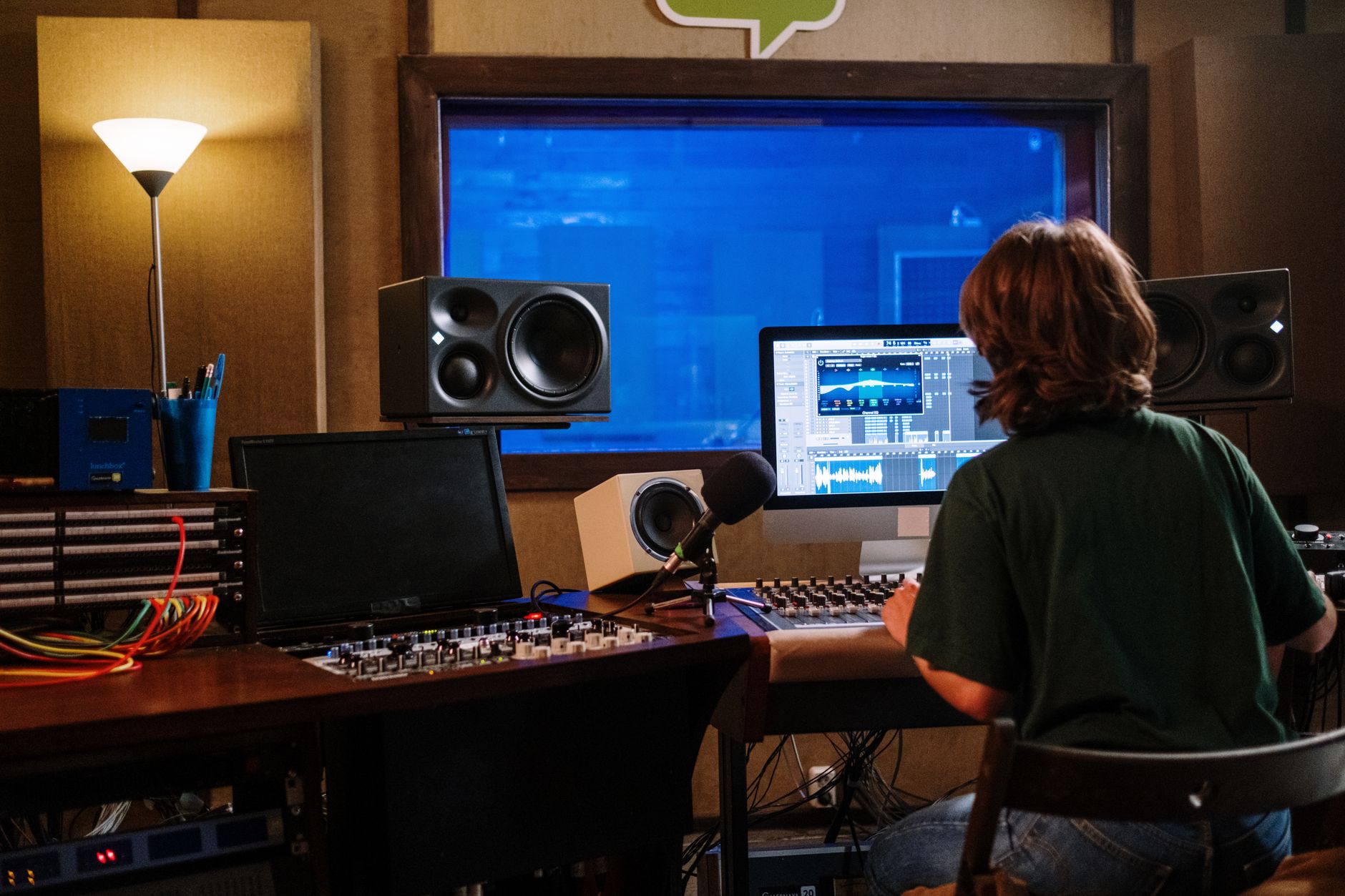
 Photo: Tranmautritam via Pexels
Both monitors share the same driver technology, crossover topology, and flat-response philosophy. The difference is woofer diameter and cabinet volume, which cascades into frequency extension, SPL headroom, and recommended room size. Everything else — build quality, connectivity, the white cone — is identical.
Specifications Compared
| Spec | Yamaha HS7 | Yamaha HS8 |
|---|---|---|
| Woofer | 6.5-inch | 8-inch |
| Tweeter | 1-inch dome | 1-inch dome |
| Freq Response | 43 Hz – 30 kHz | 38 Hz – 30 kHz |
| Power (LF/HF) | 60W / 35W | 75W / 35W |
| Max SPL | 95 dB | 97 dB |
| Dimensions (H×W×D) | 332 × 220 × 284 mm | 390 × 254 × 332 mm |
| Weight | 9.8 kg | 13.0 kg |
| Inputs | XLR + TRS | XLR + TRS |
| Room EQ | ±2 dB room controls | ±2 dB room controls |
| Street Price | ~$399 each | ~$499 each |
Low-Frequency Performance: Where They Actually Differ
Both monitors roll off below their rated floor, so the real question is how each one behaves approaching that floor in your specific room. At 40 Hz, the HS8 is still producing output; the HS7 is already tapering. For kick drums, bass guitars, and sub-bass synthesis, that 5 Hz extension is genuinely audible — but only if your room can reproduce it accurately.
 Photo: Tony Entz via Pexels
Bass frequencies below ~80 Hz are strongly affected by room dimensions. Standing waves, room modes, and corner buildup mean that a monitor with deeper extension doesn’t automatically give you more accurate bass — in small rooms, it often gives you louder, uneven bass that masks mix problems rather than revealing them.
Published acoustic data and acoustic engineering consensus consistently show that 8-inch woofers in rooms smaller than 120–150 sq ft tend to excite the first axial modes more aggressively than 6.5-inch drivers. The HS7, in a smaller space, often yields a more reliable translation to other playback systems.
If you’re mixing electronic music with genuine sub content (sub-bass synths at 30–40 Hz), neither monitor gets you there without a subwoofer — but the HS8 gives you a closer look at the 40–60 Hz region where bass weight lives.
Room Size: The Real Deciding Factor
Match monitor size to room size. The HS7 is designed for rooms roughly 10–15 ft × 10–12 ft. The HS8 suits rooms 15 ft × 15 ft and up, with adequate acoustic treatment. Running HS8s in a small untreated bedroom typically produces bass-heavy monitoring that makes you thin out your low end unnecessarily.
 Photo: Boris Pavlikovsky via Pexels
Yamaha’s own published room-size guidance aligns with this: the HS7 is rated for “small rooms,” the HS8 for “medium rooms.” Without treatment, both monitors will reflect energy off parallel walls and create peaks and nulls across the frequency range — the HS8 will just create larger peaks because it’s moving more air.
If you can’t treat your room, a smaller monitor closer to a neutral position is almost always the better call. Nearfield positioning — monitors 3–4 feet from your ears — reduces room interaction, and the HS7’s smaller form factor naturally lends itself to closer nearfield placement.
Gear Review: Yamaha HS7
Specs
| Category | Detail |
|---|---|
| Connections | XLR balanced, TRS balanced |
| I/O count | 1 in (per unit) |
| Preamps/Drivers | Built-in bi-amp: 60W LF + 35W HF |
| Bit depth/Sample rate | Analog (no digital input) |
| Bus power | No — IEC mains power |
| Best For | Bedroom studios, small mixing rooms, nearfield use |
The HS7 hits a sweet spot for home studio producers working in rooms under 150 sq ft. The 6.5-inch woofer and 1-inch tweeter deliver the flat, honest response Yamaha tuned into the HS line — no artificial hyping of highs or lows. The Room Control (–2 dB / –4 dB shelf below 500 Hz) and High Trim (±2 dB above 2 kHz) give you practical tools to compensate for placement near walls.
The white cone is a visual trademark but the technology behind it matters: polypropylene drivers resist humidity and temperature variation, which matters in home environments without climate control. Build quality is solid and consistent with the Yamaha NS-10 legacy the HS line descends from.
Verdict by archetype:
- First-time beginner: Best choice — more forgiving in typical bedroom conditions, accurate enough to build real mix skills
- Bedroom producer: Strong recommendation — accurate, industry-standard, appropriate scale for the room
- Gigging musician (home practice/recording): Good fit for tracking and rough mixing
- Prosumer mixing engineer (small treated room): Solid workhorse, though some prefer the HS8 for its sub extension
Gear Review: Yamaha HS8
Specs
| Category | Detail |
|---|---|
| Connections | XLR balanced, TRS balanced |
| I/O count | 1 in (per unit) |
| Preamps/Drivers | Built-in bi-amp: 75W LF + 35W HF |
| Bit depth/Sample rate | Analog (no digital input) |
| Bus power | No — IEC mains power |
| Best For | Medium rooms, bass-heavy genres, treated spaces |
The HS8 extends the HS formula to an 8-inch woofer with 75W of LF amplification. According to Yamaha’s published specifications, frequency response reaches 38 Hz — meaningful headroom for tracking and mixing bass instruments, kick drums, and synthesizers with genuine low-end content. The larger cabinet also produces higher maximum SPL (97 dB vs 95 dB), useful for auditioning mixes at moderate reference levels without clipping.
The same Room Control and High Trim switches carry over from the HS7. In practice, the –4 dB low shelf becomes especially important if you’re placing the HS8 near a rear wall — without it, boundary reinforcement will skew your perception of the 80–200 Hz region.
 Photo: Kyle Loftus via Pexels
Verdict by archetype:
- First-time beginner: Risky in small untreated rooms — bass buildup can mislead your mixing decisions
- Bedroom producer (small room): Usually not recommended unless room is treated
- Gigging musician: Overkill for most use cases; the HS7 is the better value
- Prosumer mixing engineer (medium treated room): The right tool — honest bass extension, adequate headroom, pro-grade accuracy
Head-to-Head Comparison
| Yamaha HS7 | Yamaha HS8 | |
|---|---|---|
| Price (each) | ~$399 | ~$499 |
| Best room size | < 150 sq ft | 150 sq ft + |
| Low-end extension | 43 Hz | 38 Hz |
| Max SPL | 95 dB | 97 dB |
| Small room accuracy | Excellent | Poor (without treatment) |
| Bass-heavy genre work | Good | Better |
| Value for bedroom studio | Excellent | Below average |
| Verdict | Default recommendation | Room-dependent upgrade |
When to Choose the HS8 Instead
Buy the HS8 if: your room is 150 sq ft or larger, you have at least basic acoustic treatment (bass traps in corners, absorption on first reflection points), and you regularly mix content with significant low-frequency energy — hip-hop, electronic, film scoring, or anything where sub-bass decisions matter.
 Photo: Maurício Mascaro via Pexels
Three specific scenarios where the HS8 earns its price premium:
- You’re mixing hip-hop or trap — kick and 808 sub sit between 40–60 Hz. The HS8 lets you make those calls with more confidence.
- You share a medium-sized studio space — the extra headroom means you can monitor at higher SPLs without distortion.
- You’re complementing a subwoofer — if you’re running a 2.1 setup, the HS8’s crossover behavior integrates more cleanly with a matching subwoofer like the Yamaha HS8S.
For everything else — pop, rock, folk, podcasting, voice-over, or any scenario where you’re working in a standard bedroom — the HS7 is the correct choice and the better investment.
→ See also:
- Focusrite Scarlett 2i2 vs Focusrite Scarlett Solo: Which Should You Buy?
- SSL 2 vs Focusrite Scarlett 2i2: Which Should You Buy?
FAQ
Is the Yamaha HS8 worth the extra $100 over the HS7? Only in the right room. In a treated medium-sized space, the HS8’s extended low-frequency response and additional headroom justify the cost. In a small bedroom, the HS7 will give you a more accurate mix environment for $100 less — the HS8’s deeper bass extension just becomes an inaccuracy you compensate for.
Can I use Yamaha HS monitors without acoustic treatment? Yes, and most people do. The Room Control switch (–2 dB or –4 dB) helps compensate for boundary bass buildup near walls. That said, acoustic treatment — even a handful of bass traps in corners — will make a larger improvement to your monitoring accuracy than any monitor upgrade. It’s the first investment to make, not the last.
Do the HS7 and HS8 need a subwoofer? For most genres, no. The HS7 reaches 43 Hz and the HS8 reaches 38 Hz, which covers the fundamental frequencies of nearly all musical instruments. If you’re mixing electronic music with sub content below 35 Hz, or doing post-production for film/TV, a matched subwoofer (the HS8S pairs well with either monitor) adds useful extension.
What audio interface pairs well with the HS7 or HS8? Both monitors accept balanced XLR and TRS inputs, so any interface with balanced outputs will work. The Focusrite Scarlett 2i2 is a common pairing for bedroom studios — its balanced monitor outputs connect directly via TRS. For a more controlled monitoring setup, a dedicated monitor controller lets you adjust levels without touching the DAW.
Are Yamaha HS monitors good for mixing if you’re a beginner? Yes — their flat response characteristic is specifically useful for building mix skills. Many commercial monitors flatter mixes by hyping highs and lows; the HS series gives you an honest picture. Mixes that translate well on HS monitors tend to translate well elsewhere. The learning curve is that they’ll expose problems in your room and your mix rather than hiding them.
How loud can Yamaha HS monitors get? The HS7 reaches 95 dB SPL maximum, the HS8 reaches 97 dB. For nearfield monitoring at 3–4 feet, typical reference levels of 75–85 dB SPL are well within the comfortable operating range of both monitors. Neither will clip at normal home-studio listening levels.
Editorial methodology: Assessments are based on manufacturer specifications, published user reviews, and editorial research. Physical hands-on testing is noted explicitly where it occurred. Rankings reflect our editorial judgment and are not influenced by affiliate commission rates. Full editorial policy · Affiliate disclosure