
Contents
Kali Audio LP-6 vs KRK Rokit 5: Which Should You Buy?
TL;DR: The Kali Audio LP-6 delivers flatter, more accurate monitoring at roughly half the KRK Rokit 5’s price — making it the stronger pick for mixing and tracking. The Rokit 5 suits producers who prefer a hyped low end and want a monitor that doubles as a listening speaker. For pure mix translation, the LP-6 wins.
Kali Audio LP-6 vs KRK Rokit 5: The Core Difference
The LP-6 is a studio tool built for accuracy; the Rokit 5 is a studio tool built for vibe. Kali’s boundary EQ and flat-by-default tuning give mixes that translate to car stereos and earbuds. KRK’s hyped low-mid curve feels good during a session but can encourage over-bright mix decisions. If your goal is mixing, choose the LP-6. If you want an immersive listening experience at your desk, the Rokit 5 delivers that well.
 Photo: Michele Raffoni via Pexels
Both monitors sit in the entry-to-midrange market, and both ship as active (powered) single units — you buy two to make a stereo pair. The comparison matters because they overlap in price and target audience, yet they make fundamentally different design choices.
Frequency Response and Sound Character
The LP-6 measures nearly flat from 47 Hz to 20 kHz (±1.5 dB in boundary position). The Rokit 5 has a well-documented low-mid bump around 200–400 Hz and a slightly elevated top end — a “V-shape” tuning that sounds exciting but flatters certain genres while masking mix problems in others.
 Photo: Brett Sayles via Pexels
Kali LP-6: Boundary EQ Is the Key Feature
Kali’s boundary EQ system offers four rear-panel switches that compensate for the bass buildup that happens when a speaker sits close to a wall or on a desk. Most bedroom studios have exactly these placement constraints. According to published measurement data from reviewers including AudioScienceReview and Sound On Sound, the LP-6 in the correct boundary position achieves accuracy that competes with monitors costing two to three times as much.
The port exits from the front, which means rear-wall placement doesn’t choke the bass — a practical advantage in small rooms. Stereo imaging is wide for a 6.5-inch driver, and the high-frequency detail is clear without harshness.
KRK Rokit 5: The Signature Sound
The Rokit 5 is the fifth generation of one of the most recognised monitor lines in home recording. The yellow Kevlar woofer and matching tweeter have been in bedroom studios and professional rooms since the 1990s. Published frequency sweeps show that 5th-gen Rokits are better measured than earlier generations, but the low-mid warmth remains a deliberate design choice.
This matters for genre: hip-hop, R&B, and electronic producers often find the Rokit’s coloration helps them judge low-end weight. Mix engineers working across genres typically find it harder to trust. The built-in DSP EQ (adjustable via KRK’s app) helps, but even with adjustments, the character stays.
Low-End Performance: 6.5-Inch vs 5-Inch Driver
The LP-6’s larger driver wins here. A 6.5-inch woofer moves more air than the Rokit 5’s 5-inch, reaching deeper into the bass with less port distortion. For anyone mixing kick drums, bass guitar, or synthesiser bass, the extra octave of usable low end reduces the reliance on subwoofer guesswork.
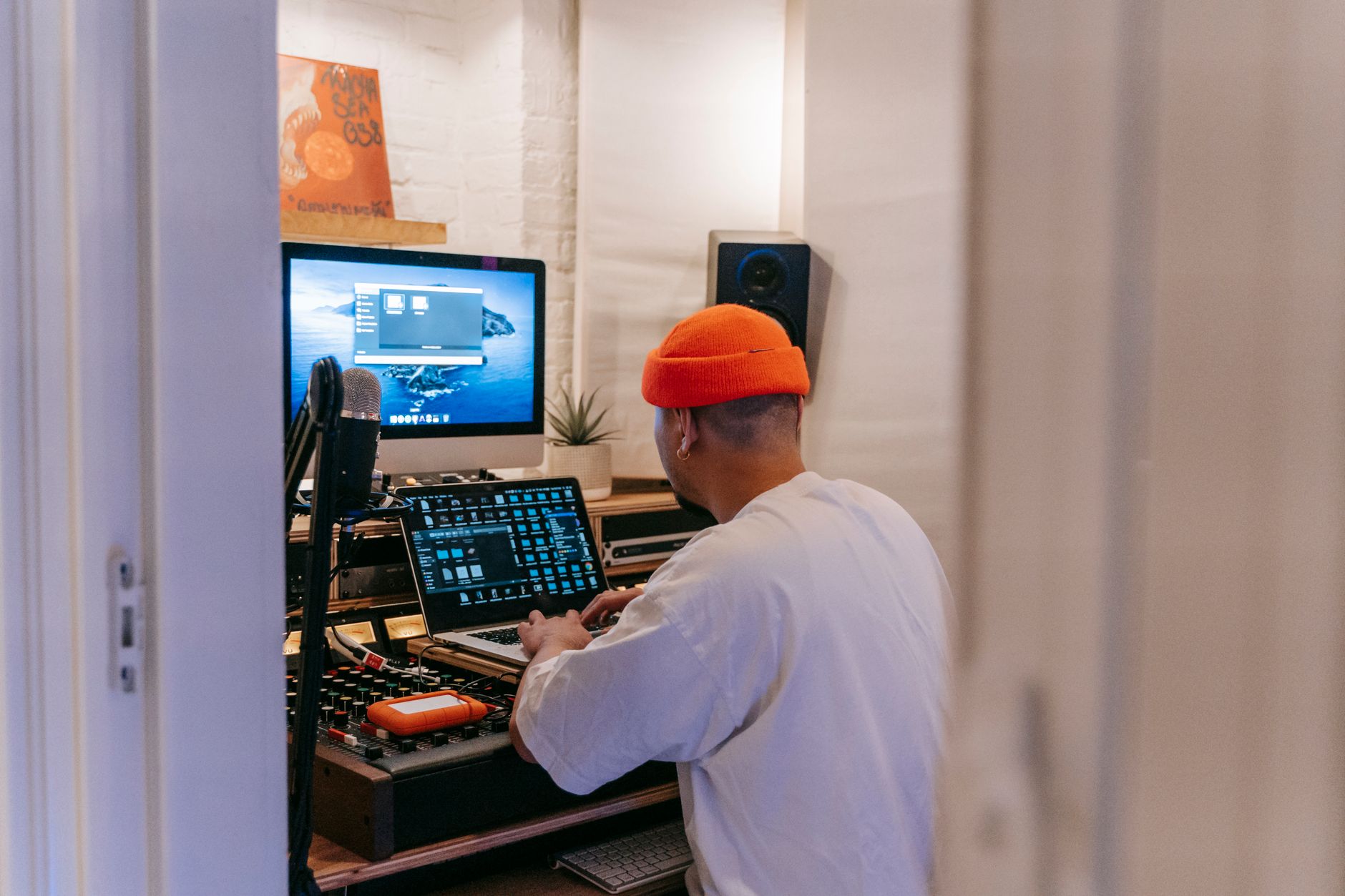 Photo: Anna Pou via Pexels
The LP-6 is spec’d down to 47 Hz usable; the Rokit 5 drops off more steeply below 60–65 Hz in practice, per published third-party measurements. Neither replaces a subwoofer for true full-range monitoring, but the LP-6 gets meaningfully closer.
One trade-off: the LP-6 is physically larger. If your desk has limited depth or you’re working on a bookshelf, the Rokit 5’s compact footprint has real value.
Build Quality and Connectivity
| Feature | Kali LP-6 | KRK Rokit 5 |
|---|---|---|
| Enclosure | MDF, vinyl wrap | MDF, vinyl wrap |
| Woofer | 6.5-inch composite | 5-inch Kevlar |
| Tweeter | 1-inch silk dome | 1-inch silk dome |
| Amplifier | 40W + 20W (biamp) | 35W + 20W (biamp) |
| Inputs | XLR, TRS, RCA | XLR, TRS |
| Boundary EQ | Yes (4-position) | No |
| DSP EQ | Limited (3-band trim) | Yes (via app) |
| Front port | Yes | No (rear port) |
| Approximate price (each) | ~$100–$110 | ~$170–$185 |
The LP-6 includes RCA inputs alongside XLR and TRS — useful for connecting a phone, secondary interface, or audio source without an adapter. The Rokit 5 drops RCA. Both use class-D amplification and both have rear-panel high and low trim controls.
Gear Review: Kali Audio LP-6
Specifications
| Spec | Detail |
|---|---|
| Connections | XLR, TRS (balanced), RCA |
| I/O count | 1 input per unit |
| Amplifier | 40W LF + 20W HF (biamp) |
| Bit depth / Sample rate | Analog monitor — N/A |
| Bus power | No (IEC mains) |
| Best For | Mixing, tracking, home studio accuracy |
Verdict by Archetype
First-time beginner: The LP-6 is the correct starting monitor. The boundary EQ prevents the most common beginner mixing mistake — trusting a bass-heavy speaker and over-brightening every mix.
Bedroom producer: Strong recommendation. Front port, boundary switches, flat response — it is purpose-built for your environment.
Gigging musician / live use: Neither monitor is designed for live monitoring. For studio demoing, the LP-6 works well.
Prosumer / home-studio engineer: The LP-6 punches significantly above its price bracket. It remains accurate enough to take mix decisions seriously up to about $1,000 in monitor spend.
Gear Review: KRK Rokit 5 G5
Specifications
| Spec | Detail |
|---|---|
| Connections | XLR, TRS (balanced) |
| I/O count | 1 input per unit |
| Amplifier | 35W LF + 20W HF (biamp) |
| Bit depth / Sample rate | Analog monitor — N/A |
| Bus power | No (IEC mains) |
| Best For | Beat-making, hip-hop, electronic, casual listening |
Verdict by Archetype
First-time beginner: Proceed with caution. The colored response will teach your ears to compensate, which takes months to unlearn.
Bedroom producer (hip-hop / electronic): A genuine fit. The Rokit 5’s low-mid warmth helps judge bass-forward arrangements, and the KRK app’s DSP gives useful room-trim options.
Gigging musician: Same caveat as the LP-6 — this is a studio monitor, not a stage tool.
Prosumer: At its price point, the Rokit 5 faces stiff competition from the LP-6 and similarly flat alternatives. Hard to recommend on accuracy grounds.
Head-to-Head Comparison
| Product | Price (each) | Woofer | Usable LF | Flat Response | Boundary EQ | Best For | Verdict |
|---|---|---|---|---|---|---|---|
| Kali LP-6 | ~$105 | 6.5-inch | ~47 Hz | Yes | Yes | Mixing, tracking | Best Buy |
| KRK Rokit 5 G5 | ~$175 | 5-inch | ~65 Hz | No (hyped) | No | Beat-making, listening | Niche pick |
 Photo: Anna Pou via Pexels
Room Placement Considerations
Small rooms — the majority of bedroom studios — are the LP-6’s natural habitat. The boundary EQ exists specifically because most monitors sound bass-heavy when placed near a wall or on a reflective desk surface. The Rokit 5 has no equivalent correction, and its rear port makes close-wall placement problematic: bass builds up and muddies the low-mid range the monitor already emphasises.
If your studio has acoustic treatment, a floating desk placement, and controlled bass response, the Rokit 5’s coloration becomes less of a liability. Most home setups don’t have that luxury.
Which Should You Buy?
Buy the Kali LP-6 if:
- You mix across genres
- Your room is untreated or acoustically compromised
- You want the most accuracy per dollar
- Your monitors sit near a wall or desktop surface
Buy the KRK Rokit 5 if:
- You produce hip-hop, trap, or electronic music and like a warm low end
- Space constraints favour the smaller footprint
- You’re already familiar with how to compensate for the Rokit’s character
- The KRK name and community support matter to you
For most buyers — especially anyone building their first serious home studio — the LP-6 is the practical choice.
→ See also:
- Focusrite Scarlett 2i2 vs Focusrite Scarlett Solo: Which Should You Buy?
- SSL 2 vs Focusrite Scarlett 2i2: Which Should You Buy?
FAQ
Is the Kali LP-6 really better than the KRK Rokit 5? For mixing accuracy, published measurements consistently show the LP-6 measuring flatter than the Rokit 5, particularly in the critical 200–500 Hz range. “Better” depends on use case — for beat-making with a preference for coloured low end, the Rokit 5 has its advocates. For engineers who need to trust their mix decisions, the LP-6 is the stronger tool.
Can I use the Rokit 5 for professional mixing work? Working professionals have used KRK Rokits on commercial releases, but they typically compensate with reference tracks and alternate playback systems. The Rokit 5’s low-mid bump requires trained ears to work around. According to expert consensus among working mix engineers, flat monitors like the LP-6 reduce the learning curve substantially.
Does the Kali LP-6 need a subwoofer? Not necessarily for basic mixing work. The 6.5-inch driver reaches to about 47 Hz usable, which covers kick drum fundamentals and most bass content. A subwoofer becomes valuable when you need to verify sub-bass decisions below 50 Hz — relevant for electronic and hip-hop production specifically.
What audio interface pairs well with the Kali LP-6 or KRK Rokit 5? Both monitors accept balanced TRS and XLR connections, so any interface with balanced monitor outputs works cleanly. The Focusrite Scarlett 2i2 and SSL 2 are common pairings at the price bracket these monitors occupy.
Are KRK Rokit 5 monitors good for casual listening, not just studio work? Yes — the Rokit 5’s hyped low mid and slightly elevated top end that causes problems in mixing contexts also makes music enjoyable to listen to casually. If your setup doubles as a hi-fi desk speaker, the Rokit 5’s character is less of a liability and more of a feature. The LP-6 sounds comparatively dry in casual listening scenarios.
How far apart should I place studio monitors for stereo imaging? The standard recommendation is an equilateral triangle: each monitor the same distance from the other and from your ears, typically 3–5 feet apart. Both the LP-6 and Rokit 5 are designed for near-field use at roughly 1–2 metres from the listening position. According to manufacturer specifications, neither is optimised for far-field or mid-field placement.
Editorial methodology: Assessments are based on manufacturer specifications, published user reviews, and editorial research. Physical hands-on testing is noted explicitly where it occurred. Rankings reflect our editorial judgment and are not influenced by affiliate commission rates. Full editorial policy · Affiliate disclosure