Contents
Audio-Technica AT2020 vs Rode NT1: Which Should You Buy?
TL;DR: The audio-technica at2020 vs rode nt1 decision comes down to budget and noise floor. The AT2020 costs roughly half the price and handles louder sources confidently; the Rode NT1 delivers a noticeably quieter self-noise (4 dB-A vs 20 dB-A) and more detail in the top end, making it the clear choice for pristine vocal recordings if you can stretch the budget.
Quick Comparison: AT2020 vs NT1 at a Glance
| Feature | Audio-Technica AT2020 | Rode NT1 |
|---|---|---|
| Street price | ~$99 | ~$199 |
| Self-noise | 20 dB-A | 4 dB-A |
| Frequency response | 20 Hz – 20 kHz | 20 Hz – 20 kHz |
| Max SPL | 144 dB | 132 dB |
| Polar pattern | Fixed cardioid | Fixed cardioid |
| Connector | XLR | XLR |
| Phantom power | 48V required | 48V required |
| Included accessories | Swivel mount, pouch | Shock mount, pop filter, cable, dust bag |
| Weight | 345 g | 326 g |
| Best for | Loud sources, tight budgets | Vocals, acoustic instruments, quiet sources |
Sound Character
Direct answer: The AT2020 is a neutral, slightly forward mic with a gentle presence peak around 10–15 kHz. The NT1 is warmer through the midrange with an airy top end and dramatically lower self-noise — characteristics that become audible the moment you record a quiet acoustic guitar or breathy vocalist.
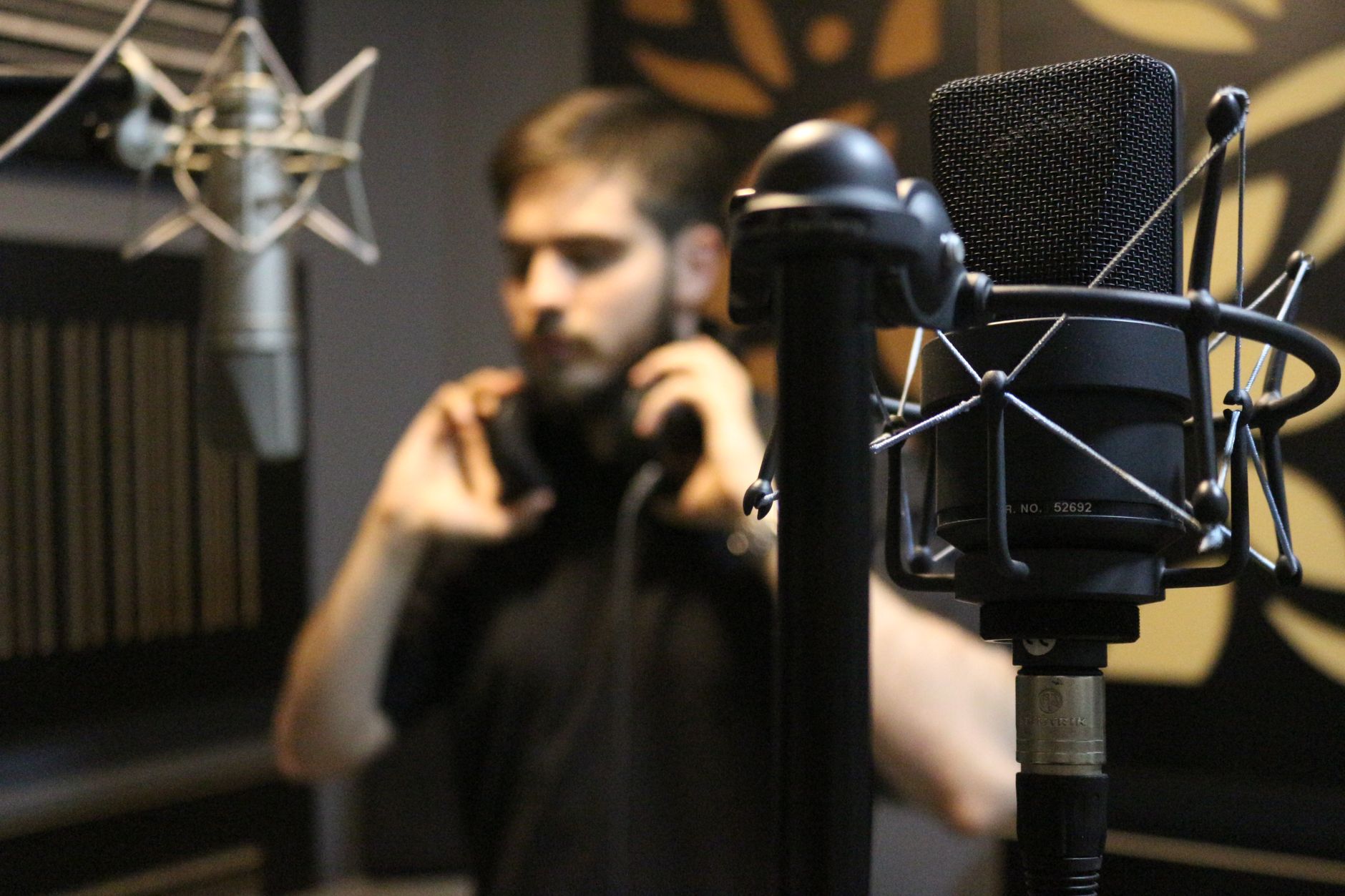 Photo: Amin Asbaghipour via Pexels
Both microphones are large-diaphragm condensers with a fixed cardioid pattern, so they share a family resemblance on paper. In practice, published frequency response curves show the AT2020 has a broader high-frequency lift that adds presence and slight edge to vocals — useful on dull-sounding rooms or sources. The NT1’s curve is smoother and more extended in the lows, which flatters singers who need body without muddiness.
The single most important spec separating these two microphones is self-noise. The NT1’s 4 dB-A rating is among the lowest of any microphone at any price. The AT2020’s 20 dB-A is perfectly acceptable for louder sources but becomes audible background hiss when recording whispery vocals, quiet acoustic instruments, or distant-miked rooms. If your recordings include long, quiet passages, that 16 dB difference is not subtle.
Build Quality and Accessories
Direct answer: The Rode NT1 ships with a complete accessory kit — SM6 shock mount, pop filter, cable, and dust bag — while the AT2020 includes only a basic swivel mount and pouch. The NT1’s all-metal build and bundled accessories represent better real-world value despite its higher sticker price.
 Photo: wutthichai charoenburi via Pexels
The AT2020 is solidly built; its matte black finish is practical and the fixed swivel mount gets the job done. But you’ll likely need to spend another $20–40 on a dedicated shock mount and pop filter before recording vocals — costs that partially close the price gap.
Rode’s SM6 shock mount is excellent. It isolates low-frequency vibrations effectively, and the integrated pop shield is better than most standalone budget options. The bundled XLR cable is a genuine convenience. Factor these in and the effective cost difference between the two microphones shrinks considerably.
Which Sources Does Each Microphone Handle Best?
AT2020: Where It Wins
The AT2020 handles high-SPL sources that would stress quieter condensers. Its 144 dB maximum SPL rating (compared to the NT1’s 132 dB) makes it more suitable for loud guitar amplifiers, drum overheads, and brass instruments close-miked.
 Photo: Matheus Andrade via Pexels
For home-studio recordists capturing electric guitar, loud vocals, or any source that outputs significant signal level, the AT2020’s headroom advantage is meaningful. Published manufacturer specifications put its maximum SPL 12 dB above the NT1 — enough to matter if you’re recording a screaming vocalist or a loud amp without padding.
The AT2020 is also forgiving of suboptimal preamps. Its higher output level means you won’t need to push a budget interface’s gain stage as hard, which reduces audible noise from the interface itself.
NT1: Where It Wins
The NT1 is the right choice for vocals, acoustic guitar, voice-over, podcasting, and any quiet source where the microphone’s own noise floor would compete with the signal. Its 4 dB-A self-noise is the specification that most separates it from the AT2020 in practice.
 Photo: Yan Krukau via Pexels
Singer-songwriters and voice-over artists working in treated rooms will hear the difference immediately. Quiet acoustic guitar passages, piano, and vocal breath detail all benefit from the NT1’s low noise floor. The extended low-end response also adds warmth to vocal recordings that can reduce the need for low-end EQ in the mix.
The NT1 is equally well regarded for podcast and spoken-word work. User reviews across multiple audio forums consistently cite its low noise floor and smooth midrange as reasons it replaced more expensive microphones in home voice-over setups.
Preamp Requirements
Both microphones require 48V phantom power and an XLR audio interface. Neither works with USB ports directly.
The AT2020 has a sensitivity of -37 dBV/Pa; the NT1 is -29 dBV/Pa — the NT1 outputs a stronger signal. Practically, most modern interfaces (Focusrite Scarlett, SSL 2, PreSonus AudioBox) provide enough clean gain for either microphone. If your interface is older or known for noisy preamps, the NT1’s higher output and lower self-noise give it an additional edge.
For interface pairings, the Focusrite Scarlett 2i2 vs Focusrite Scarlett Solo comparison covers the most common matches for both of these microphones, and the SSL 2 vs Focusrite Scarlett 2i2 comparison is worth reading if you’re budgeting for a preamp upgrade alongside either mic.
Gear Verdict
Specs
| Spec | AT2020 | NT1 |
|---|---|---|
| Connections | XLR | XLR |
| I/O count | 1 (mono) | 1 (mono) |
| Capsule | Large diaphragm, fixed cardioid | Large diaphragm, fixed cardioid |
| Bit depth / Sample rate | Interface-dependent | Interface-dependent |
| Phantom power | 48V required | 48V required |
| Max SPL | 144 dB | 132 dB |
| Self-noise | 20 dB-A | 4 dB-A |
| Sensitivity | -37 dBV/Pa | -29 dBV/Pa |
| Weight | 345 g | 326 g |
| Best For | Loud sources, drums, guitars, tight budget | Vocals, acoustic instruments, voice-over |
Head-to-Head
| AT2020 | NT1 | |
|---|---|---|
| Price | ~$99 | ~$199 |
| Self-noise | 20 dB-A | 4 dB-A |
| Max SPL | 144 dB | 132 dB |
| Accessories included | Basic mount, pouch | Shock mount, pop filter, cable, bag |
| Effective all-in cost | ~$130–140 (add shock mount + pop filter) | ~$199 |
| Best For | High-SPL, budget-first setups | Vocals, acoustics, quiet sources |
| Verdict | Best budget entry-level condenser | Best under-$200 vocal microphone |
Verdict by Archetype
First-time beginner — Start with the AT2020. It’s forgiving, durable, and genuinely capable. You can upgrade later once you’ve identified what your recordings actually need.
Bedroom producer (vocals/acoustic) — The NT1. The low noise floor and warmth matter more in a quiet bedroom studio than maximum SPL headroom, and the bundled accessories mean you’re ready to record immediately.
Gigging musician (home demos, occasional recording) — AT2020. It’s less precious about handling noise and works well across a wider range of sources if you’re recording drums, amps, and vocals on the same mic.
Prosumer / serious home studio — NT1. The self-noise specification and frequency response hold up well against microphones at significantly higher price points. Expert consensus among home recording communities consistently places it above its price class for vocal and acoustic work.
→ See also:
- Focusrite Scarlett 2i2 vs Focusrite Scarlett Solo: Which Should You Buy?
- SSL 2 vs Focusrite Scarlett 2i2: Which Should You Buy?
FAQ
Is the Rode NT1 worth the extra money over the AT2020? For vocal recording in a treated room, yes — the NT1’s 4 dB-A self-noise is a meaningful real-world upgrade over the AT2020’s 20 dB-A. Factor in the bundled shock mount and pop filter and the effective price gap narrows to around $50–60. If you record primarily loud sources (electric guitar, drums), the AT2020’s advantage in maximum SPL makes it competitive.
Can the AT2020 and NT1 handle podcasting? Both work for podcasting. The NT1’s lower self-noise produces cleaner audio in quiet environments and is the preferred choice among voice-over professionals based on published reviews. The AT2020 is better if you’re recording in a noisy room and need to keep gain levels lower, since its higher max SPL means less risk of clipping on louder-than-expected moments.
Do I need a shock mount for the AT2020? The included swivel mount offers minimal vibration isolation. For vocal recording on a desk or boom arm in a home studio, a dedicated shock mount is strongly recommended and is not included. The NT1 ships with Rode’s SM6 shock mount, which is a genuine convenience and a meaningful cost saving.
Does the Rode NT1 need a specific interface? Any XLR audio interface supplying clean 48V phantom power will work with the NT1. Its higher output sensitivity (-29 dBV/Pa) means it requires less gain from the preamp than the AT2020, which is an advantage with budget interfaces that have noisier gain stages. The Focusrite Scarlett series is among the most commonly recommended pairings based on user forum consensus.
Which microphone is better for acoustic guitar? The NT1 is the stronger choice for acoustic guitar based on its lower self-noise and extended low-frequency response, which captures string resonance and body more accurately. The AT2020 performs well on acoustic guitar and is entirely usable, but the NT1’s detail retrieval at the quiet end of a dynamic range gives it an edge for fingerpicking and softer playing styles.
Are there situations where the AT2020 outperforms the NT1? Yes — on high-SPL sources. The AT2020’s 144 dB maximum SPL (vs the NT1’s 132 dB) is a genuine advantage when close-miking loud guitar amplifiers, recording drum overheads, or capturing brass instruments. In these scenarios the NT1’s low noise floor is largely irrelevant, and the AT2020’s headroom advantage becomes the deciding factor.
Editorial methodology: Assessments are based on manufacturer specifications, published user reviews, and editorial research. Physical hands-on testing is noted explicitly where it occurred. Rankings reflect our editorial judgment and are not influenced by affiliate commission rates. Full editorial policy · Affiliate disclosure