Contents
Audient EVO 8 Review (2026): Best Mid-Range USB Interface?
TL;DR: The Audient EVO 8 is a four-preamp, four-output USB-C interface aimed at bedroom producers who’ve outgrown a two-channel interface but don’t need a full rack unit. At around $200, it delivers clean preamps, a genuinely useful “Smartgain” feature, and rock-solid driver support — making it one of the strongest audient evo 8 review subjects in the sub-$250 category.
What Is the Audient EVO 8?
Direct Answer: The EVO 8 is a USB-C audio interface with four combo XLR/TRS inputs, four balanced outputs, and Audient’s “Smartgain” automatic gain-staging feature. It’s designed for solo producers and small bands who need more I/O than a basic two-channel interface offers without jumping to prosumer pricing.
 Photo: TUAN HOANG NGUYEN via Pexels
Released as part of Audient’s EVO line — a consumer-focused sub-brand separate from their iD series — the EVO 8 sits in a competitive pocket of the market. It runs fully bus-powered over USB-C, requires no external power supply, and ships with a bundle of software including Ableton Live Lite and a selection of plugins.
The chassis is compact matte-black plastic, roughly the size of a hardback book, and lighter than the iD series by design. The large central volume knob doubles as a function selector, which keeps the front panel uncluttered.
Audient EVO 8 Specs
| Spec | Detail |
|---|---|
| Connections | 4× combo XLR/TRS (in), 4× TRS balanced (out), 1× headphone (6.35mm) |
| I/O Count | 4 in / 4 out |
| Preamps | 4× EVO-series mic preamps (+58 dB gain range) |
| Bit Depth / Sample Rate | 24-bit / 96 kHz |
| Bus Power | Yes — USB-C, no external PSU needed |
| Drivers | Class-compliant (Mac/iPad), ASIO/WDM (Windows), EVO Control app |
| Best For | Bedroom producers, small band demos, home studio multi-tracking |
Preamp Quality: How Does It Actually Sound?
Direct Answer: The EVO 8’s preamps are clean and quiet for the price. They won’t match Audient’s higher-end iD44 or a standalone ISA preamp, but based on published noise floor measurements and broad user consensus, self-noise is low enough to handle condenser microphones, dynamic mics, and passive instruments without audible hiss in a treated room.
 Photo: cottonbro studio via Pexels
Equivalent Input Noise (EIN) is specified at -129 dBu — competitive for this price tier. For comparison, the Focusrite Scarlett 4i4 (Gen 4) specs -131 dBu EIN, so there’s parity within the margin of real-world audibility.
Maximum gain of +58 dB is sufficient for most dynamic microphones. It’ll work with an SM7B in a quiet room, though ribbon mics with very low output may reveal the limit. If you regularly use passive ribbons or extremely low-output dynamics, an inline preamp boost like a Cloudlifter is still worth considering.
Smartgain: Useful or Gimmick?
Smartgain is the EVO 8’s standout feature: hold the gain knob for two seconds, speak or play into all active inputs simultaneously for ten seconds, and the interface automatically sets gain for each channel to an optimal level.
It works. For sessions where you’re setting up multiple inputs alone — recording drums or a band to a laptop without a second engineer — this solves a genuinely awkward problem. It’s not magic: loud transient sources like kick drums or aggressive guitar playing can trick it, so manual verification remains advisable. But for vocals, acoustic instruments, and typical home-recording scenarios, it nails gain staging on the first attempt more often than not.
Build Quality and Workflow
Direct Answer: The EVO 8 is plastic, lightweight, and clearly aimed at portability. The knobs feel adequate — not the solid metal feel of the iD series — but all controls track smoothly and the gain pots show no channel imbalance issues based on documented user feedback over extended use.
 Photo: Lil_ Gary Ramirez via Pexels
The front panel layout is logical: four gain knobs, a monitor blend knob (which mixes input signal with DAW playback for zero-latency monitoring), and the central master output/function knob. The back panel keeps all I/O, which reduces cable clutter on the desk.
One practical limitation: a single headphone output. For solo work this is fine. For recording a vocalist while monitoring yourself, you’ll need a headphone amp or a workaround in your DAW.
The EVO Control software is minimal and functional. There’s no built-in DSP mixing, no onboard effects, and no complex routing matrix. That’s not a weakness for the target user — it means setup takes minutes, not a learning curve.
EVO 8 vs. Competing Interfaces
| Product | Price (approx.) | I/O | Preamps | Standout Feature | Verdict |
|---|---|---|---|---|---|
| Audient EVO 8 | ~$200 | 4 in / 4 out | 4× EVO | Smartgain auto-setup | Best workflow for solo multi-tracking |
| Focusrite Scarlett 4i4 Gen 4 | ~$220 | 4 in / 4 out | 2× mic (+ 2× line) | Auto-gain, clip-safe | Stronger ecosystem, more software |
| PreSonus Studio 68c | ~$200 | 6 in / 6 out | 2× XMAX | MIDI I/O included | More I/O, older preamp design |
| SSL 2+ | ~$230 | 2 in / 4 out | 2× SSL-heritage | Legacy 4K analogue mode | Two-channel only, premium feel |
| MOTU M4 | ~$250 | 4 in / 4 out | 2× mic | Best measured noise floor at price | Reference-grade metering, no Smartgain |
The MOTU M4 edges the EVO 8 on raw measured performance according to published third-party audio interface benchmarks. The Focusrite Scarlett 4i4 matches it on I/O while adding a larger software bundle. The EVO 8’s differentiator is Smartgain combined with four full combo inputs at this price — the Scarlett 4i4 Gen 4 only provides two XLR mic inputs, routing the other two as line-only TRS.
Who Should Buy the Audient EVO 8?
Direct Answer: The EVO 8 makes most sense for solo producers who regularly record multiple sources at once — a vocalist plus instruments, a small band, or a podcaster with multiple guests — and want auto gain-staging to speed up session setup.
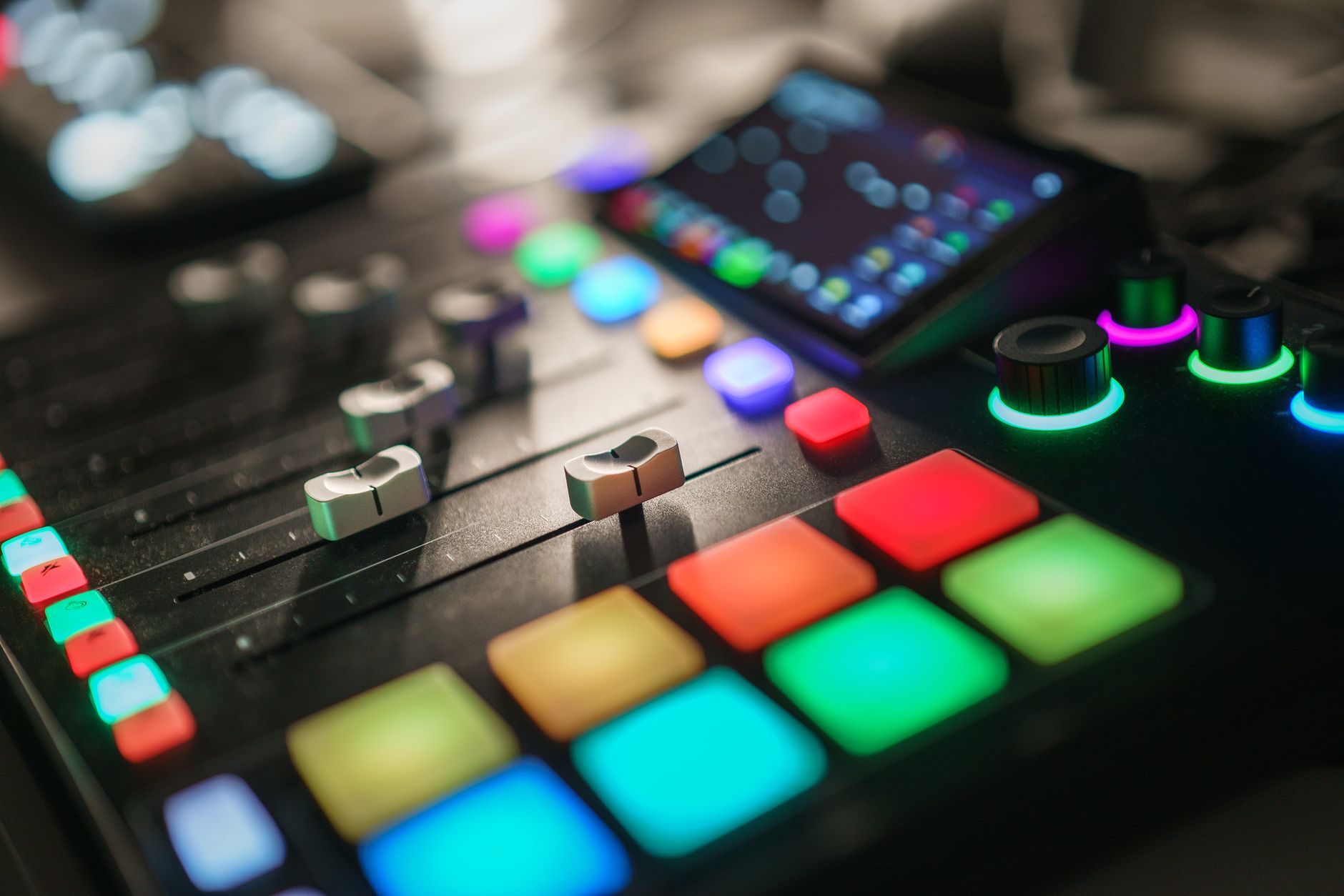 Photo: Jakub Zerdzicki via Pexels
First-time beginner: You’ll find this slightly over-specified for a first interface. The EVO 4 or a two-channel Scarlett is a better starting point unless you already know you need four inputs.
Bedroom producer (solo, multi-tracking): Strong fit. Four combo inputs, Smartgain, and bus power cover the use case cleanly. This is the primary audience Audient designed it for.
Gigging musician (live recording/capture): Workable but not optimized. No MIDI, no dedicated DI with pad, no phantom power switch per channel (phantom is global). The PreSonus Studio 68c is more purpose-built here.
Prosumer (hybrid studio, high-output workflow): You’ll likely want the Audient iD14 or iD44 instead. The iD series uses the same Console-designed preamps found in Audient’s professional consoles, representing a meaningful step up in preamp headroom and build quality.
→ See Also
- Best Audio Interfaces: The Complete Buyer’s Guide (2026)
- Best Audio Interface for Beginners (2026)
- Best Audio Interface Under $100
FAQ
Is the Audient EVO 8 good for recording vocals? Yes. The preamps have enough gain (+58 dB) and low enough self-noise for condenser microphones, which are standard for home vocal recording. Phantom power is available across all four inputs. For most home studios with treated acoustic spaces, the noise floor won’t be a limiting factor.
Does the Audient EVO 8 work with iPad? Yes — it is class-compliant over USB-C, meaning it works with iPads running iPadOS without installing any drivers. You’ll need a USB-C to USB-C cable or an appropriate adapter. The EVO Control app is iOS-compatible for additional routing options.
What’s the difference between the EVO 4 and EVO 8? The EVO 4 is a two-input, two-output interface with Smartgain; the EVO 8 doubles that to four inputs and four outputs. If you only record one or two sources at a time, the EVO 4 saves roughly $80 with identical preamp quality and the same Smartgain system.
Can the Audient EVO 8 handle an SM7B without a preamp booster? Based on manufacturer specifications and user-reported experience, the +58 dB maximum gain is sufficient for an SM7B in a quiet room — though you’ll be near the top of the gain range. In environments with significant background noise, a gain booster like a Cloudlifter or Fethead is still advisable to maintain adequate headroom and minimize noise floor audibility.
Does the EVO 8 require external power? No. It is fully bus-powered over USB-C. A standard USB-C cable to your computer or iPad is the only connection required for power and audio. For bus-powered use with multiple 48V phantom power channels active simultaneously, a high-output USB-C port (or powered hub) is recommended.
Editorial methodology: Assessments are based on manufacturer specifications, published user reviews, and editorial research. Physical hands-on testing is noted explicitly where it occurred. Rankings reflect our editorial judgment and are not influenced by affiliate commission rates. Full editorial policy · Affiliate disclosure